I Counted Every Ad on Instagram and Facebook for One Hour
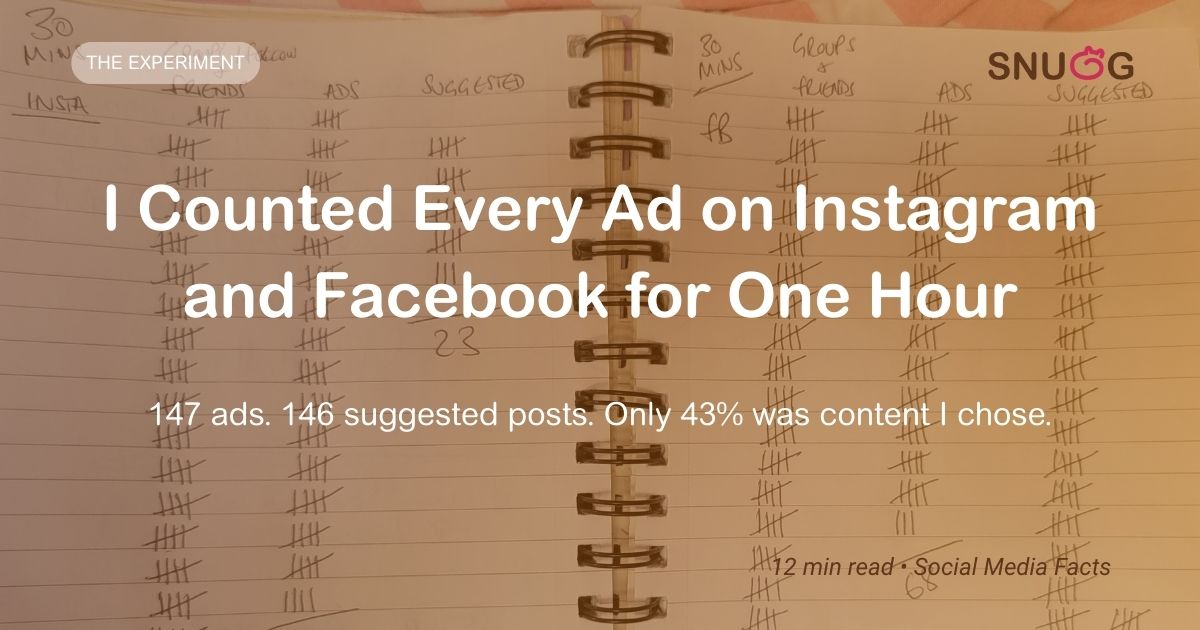
Well that's an hour of my life I'll never get back again!
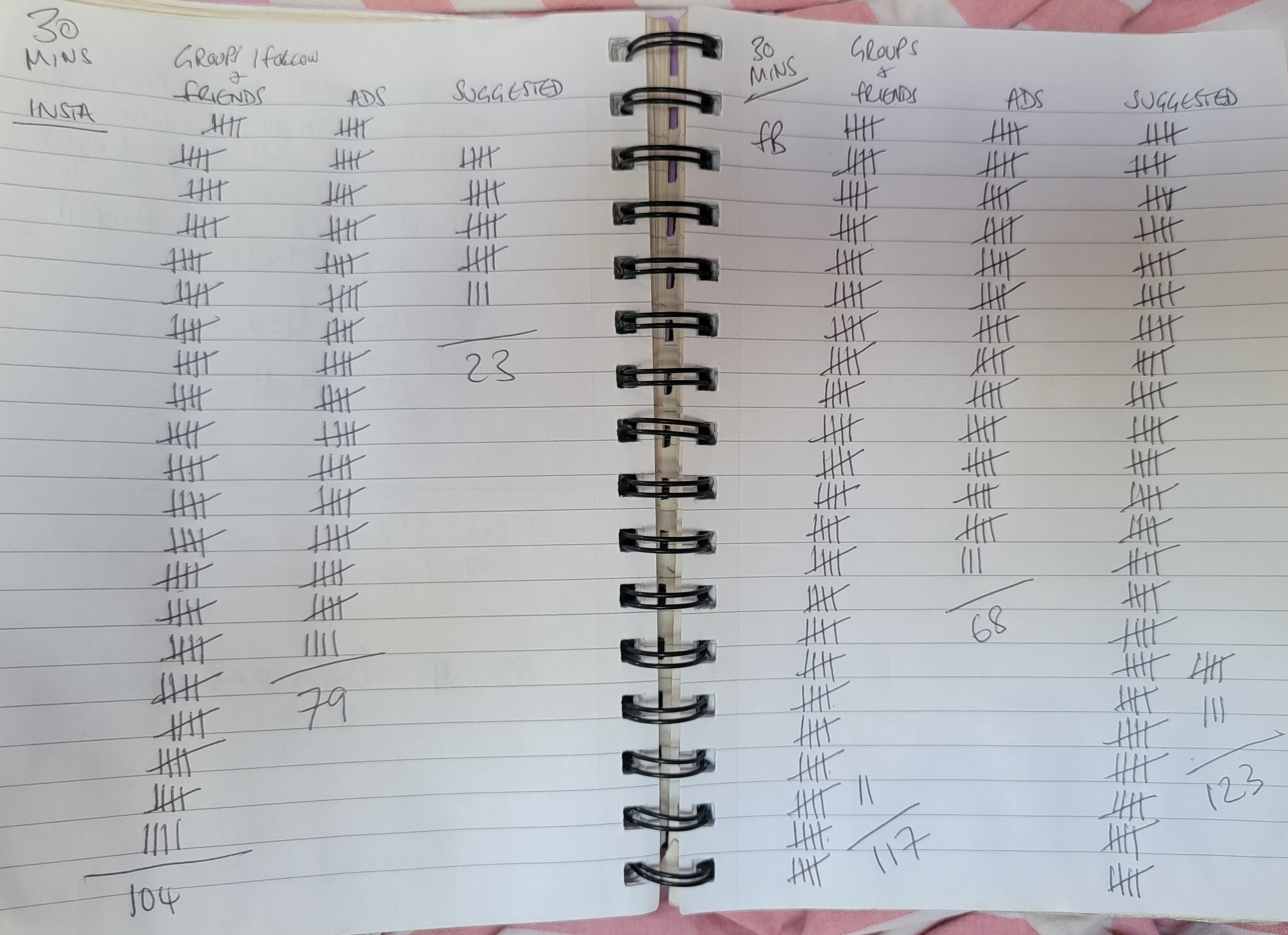
This morning, I did something masochistic. I sat down with a notebook and counted every single piece of content Instagram and Facebook showed me for 30 minutes each.
I made tally marks, documenting how much of my feed was advertising versus actual content from people I know.
The results are quite astounding, and I'm already building an alternative social media platform because I knew how bad things had got.
But seeing the numbers in black and white? That's something else.
The Experiment
Date: January 2026
Duration: 30 minutes on Instagram, 30 minutes on Facebook
Method: Manual tally in a notebook for every item shown
Categories: People I follow, Ads, Suggested content
Device: My personal phone
Account age: 15+ years on both platforms
I didn't do anything unusual. Just normal scrolling. The kind of mindless browsing we all do while waiting for coffee or procrastinating on actual work.
I didn't click on anything. Didn't interact. Just scrolled and counted.
The Results: Instagram (30 Minutes)
- Accounts I follow: 104 items
- Ads: 79 items
- Suggested content: 23 items
Let that sink in for a second.
In 30 minutes of Instagram:
- 50% was content I actually chose to see
- 38% was advertising
- 11% was strangers the algorithm decided I should see
One ad every 23 seconds of scrolling.
The Results: Facebook (30 Minutes)
- People and groups I follow: 117 items
- Ads: 68 items
- Suggested content: 123 items
Facebook was different. But honestly? Worse in its own way.
- 38% was content I chose to see
- 22% was advertising
- 40% was suggested content from people I never chose to follow
Think about that for a second. 40% of my Facebook feed was content from strangers.
Not friends. Not groups I joined. Random people and pages Facebook's algorithm decided I should see.
The One-Hour Total: 147 Ads (Plus 146 Algorithmic Suggestions)
Adding both platforms together, here's what I experienced in one hour of "social" media:
Total items shown: 514
- 221 posts from people and groups I follow (43%)
- 147 ads (29%)
- 146 pieces of suggested content from strangers (28%)
Only 43% of what I saw was content I actually chose to see.
More than half my feed—57%—was either advertising or algorithmic suggestions I never asked for. (This is what happens when platforms are funded by advertising instead of subscriptions.)
But My Calculation Is Actually Conservative
It gets worse.
My experiment assumes you spend one hour per day total on Instagram and Facebook combined.
That's actually below average. Way below.
According to research from Statista and DataReportal (February 2025), the actual numbers are:
- Global average: 141 minutes (2 hours 21 minutes) per day on social media<sup>1</sup>
- US average: 136 minutes (2 hours 16 minutes) per day<sup>1</sup>
- Ages 18-24 in US: 186 minutes (3 hours 6 minutes) per day<sup>2</sup>
- US teens (13-19): 288 minutes (4 hours 48 minutes) per day<sup>2</sup>
So let's do the maths for what people are actually experiencing.
The Real Numbers: What You're Actually Seeing
If You're an Average User (2h 16m per day):
Per Day:
- 333 ads
- 331 suggested posts from strangers
- 33 minutes watching unwanted content
Per Year:
- 121,545 ads
- 120,815 suggested posts
- 201 hours (13 full days) on content you didn't choose
If You're 18-24 Years Old (3h 6m per day):
Per Day:
- 454 ads
- 451 suggested posts
- 45 minutes watching unwanted content
Per Year:
- 165,710 ads
- 164,615 suggested posts
- 274 hours (17.6 full days) on content you didn't choose
If You're a Teen (4h 48m per day):
Per Day:
- 704 ads
- 699 suggested posts
- 70 minutes watching unwanted content
Per Year:
- 256,960 ads
- 255,135 suggested posts
- 424 hours (27.4 full days) on content you didn't choose
If you're a teenager who uses social media at the average rate, you're spending nearly four weeks of every year watching ads and content from strangers you never chose to follow.
Let that sink in.
You Didn't Choose This
When I joined Facebook in 2009, my feed showed posts from my friends. In chronological order. That was it.
No ads. No algorithm. No suggested content.
When Instagram launched in 2010, it was a simple photo-sharing app. You saw photos from people you chose to follow. In the order they posted them.
You chose to connect with friends and family.
Meta chose to monetise your attention and fill your feed with advertising and strangers.
There was no vote. No consent. They just... changed it. Slowly enough that we barely noticed until it was too late. (I wrote a deep dive on how social media got this bad if you want the full history. And TikTok accelerated this trend by proving addiction is profitable.)
The Instagram vs Facebook Difference
Something else I noticed during my experiment: managing what you see is dramatically different between the two platforms.
Instagram: Relatively Easy to Curate
When you see content you don't want on Instagram:
- Tap the three dots on any post
- Select "Unfollow" or "Mute"
- Takes literally 2 seconds
- You can mute someone's stories separately from their posts
- The interface is straightforward
It's not perfect. The algorithm still controls what you see from accounts you do follow. But at least you have some control over the "following" part of the equation.
Facebook: Deliberately Difficult
Want to unfollow someone on Facebook without unfriending them?
- Click on their profile
- Click on "Friends" or "Following"
- Find the dropdown menu
- Select "Unfollow"
- Navigate through confirmation screens
Want to stop seeing posts from a group without leaving it?
- Go to the group
- Click the three dots
- Find "Manage notifications"
- Choose from yet another menu
- Hope Facebook actually respects your choice (spoiler: they won't)
It's designed to be tedious.
Here's why that matters: the harder it is to curate your feed, the more likely you are to just... not do it.
And if you don't curate your feed, Facebook fills it with whatever keeps you scrolling longest.
Which—based on my data showing 40% suggested content—is apparently posts from complete strangers.
And What Really Pissed Me Off?
I've spent years clicking "Hide ad" on Facebook.
Years clicking "Not interested" on suggested content.
Years selecting specific reasons: "Irrelevant," "I've seen this too many times," "Not interested in this topic."
Facebook ignores it.
The same types of ads appear again. Different products, same targeting. Different random pages in my suggested content. Same algorithmic logic.
They don't care what I want to see.
They care what keeps me on the platform long enough to see more ads.
My preferences aren't the point. My attention is.
The Real Cost
This isn't just about wasted time. Though it is wasted time.
For the average user spending 201 hours per year on ads and unwanted content, here's what you could do instead:
- Read 67 books
- Learn conversational Spanish or French
- Complete a professional certification
- Have 201 one-hour conversations with actual friends
- Get an extra 13 days of sleep per year
- Write a novel
- Learn to play an instrument
- Build something
But instead, you're watching ads for things you mostly don't want, interrupted by posts from strangers you never asked to follow, with occasional content from people you know sprinkled in.
That's not social media. That's attention extraction.
"But These Apps Are Free!"
Are they?
Meta made $164 billion in 2024. Ninety-eight percent came from advertising.
That's $164,000,000,000 extracted from making your experience worse.
The average user in US/Canada generates approximately $60 per year in ad revenue for Meta.
In my one-hour experiment:
- 514 items shown
- 293 weren't content I chose
- 147 ad impressions
- Approximate value to Meta: $0.24
- Cost to me: An hour I'll never get back
Multiply that by 3.07 billion Facebook users and 2.4 billion Instagram users. Every single day.
You're not the customer. You're the product.
Your attention is what they're selling to advertisers. Your feed is what they're filling with strangers to boost "engagement metrics."
That's not free. That's expensive.
What You Can Do About This
Short Term
1. Set aggressive time limits
Use your phone's built-in app timers. 15-30 minutes per day total. Maximum.
2. Check your actual usage first
Most people underestimate their time on social media by 50% or more. Check your phone's screen time stats. The truth might shock you.
3. Curate aggressively on Instagram
Unfollow liberally. Mute people you don't want to see. It's easier there than Facebook. Your feed, your rules.
4. Accept Facebook's limitations
Between the 40% suggested content and the deliberately difficult unfollowing process, Facebook is designed to show you what Meta wants, not what you want. Lower your expectations or delete it.
5. Turn off all notifications
Every single one. Check on your terms, not theirs.
6. Ask yourself every time you open the app
"Is this making my life better?" Be honest with your answer.
Long Term
Understand that platforms funded by advertising will always optimise for advertiser interests, not yours.
It's not a bug. It's the business model. (I explored this in more detail in why social media without ads is the only way forward.)
The only way to get a social media experience that serves you is to be the actual customer.
Which means paying for it.
There's a Better Way
I started building Snugg because I got tired of being the product.
No ads. Not now. Not ever.
No algorithm deciding what you see.
No suggested content from strangers.
Just your people, in chronological order.
A finite feed where you can actually be "all caught up".
It costs €5/month - €3 if you are one of the first 1,000 - instead of your privacy, attention, and sanity.
Different business model. Different incentives. Different experience.
We're launching private beta in February 2026.
Join the people on the waitlist at snugg.social.
Try It Yourself
I challenge you: spend 30 minutes on Instagram or Facebook with a notebook.
Count every ad.
Count every post from friends.
Count the suggested content from strangers.
Then decide if this is really how you want to spend your time.
What did you find? Share on Twitter/X @Snugg_Social with your numbers.
Sources
1. Statista & DataReportal (2025). "Daily time spent on social networking by internet users worldwide." Global average: 141 minutes per day; US average: 136 minutes per day. https://www.statista.com/statistics/433871/daily-social-media-usage-worldwide/
2. BroadbandSearch (2025). "Average Daily Time Spent on Social Media (Latest 2024 Data)." US adults aged 18-24: 186 minutes per day; US teens spend significantly more time on average. https://www.broadbandsearch.net/blog/average-daily-time-on-social-media
3. Meta Platforms Inc. Q4 2024 Earnings Report. Total revenue: $164 billion (2024), 98% from advertising. https://investor.atmeta.com/investor-news/press-release-details/2025/Meta-Reports-Fourth-Quarter-and-Full-Year-2024-Results/
4. Meta Platforms Inc. Q4 2024 Earnings Report. Average revenue per user (ARPU) US/Canada: ~$60 annually. https://investor.atmeta.com/investor-news/press-release-details/2025/Meta-Reports-Fourth-Quarter-and-Full-Year-2024-Results/
5. Statista (2025). "Most popular social networks worldwide as of January 2025, ranked by number of monthly active users." Facebook: 3.07 billion MAU; Instagram: 2.4 billion MAU.
About the Author
I'm a yacht skipper and surveyor in the Caribbean and the founder of Snugg. After 15 years watching social media prioritise ads over connection, I decided to build the alternative. Previously built a sailing holiday business, topping Google for years before algorithm changes killed organic reach. Not a developer or privacy activist—just someone who got tired of platforms that forgot their purpose. When I'm not building Snugg or surveying yachts, I wish everyone had more time for sailing (or whatever brings them joy).
If this resonated with you, share it with someone who feels the same frustration. Together, we can build something better.