We Asked 35 People What They Hate About Social Media. Privacy Ranked 4th.
I'm 4,000 miles from my family in the UK. These platforms were supposed to keep us connected. So when they started getting terrible, I felt it personally.
We surveyed 35 people about what frustrates them most about social media. Privacy concerns ranked 4th at 60%.
Here's what beat it.
The Survey
Before I share what we found, full transparency: this is early data. We're at 35 responses and counting. These are preliminary findings, not definitive conclusions.
But the patterns are already clear. And honestly? They didn't really surprise me.
What we asked:
- What frustrates you most about existing social platforms?
- What do you actually value in social media?
- How many people would you realistically bring to a new platform?
- What would make you switch?
Who responded:
Real people who use social media daily. Not privacy activists. Not tech experts. Just regular people who are sick of how these platforms have changed.
And that's exactly why their answers matter.
What We Found: The UX Frustration Triangle
Three things tied for the top spot. Not privacy violations. Not data concerns.
User experience problems.
77.1% - Too much AI-generated content
74.3% - Ads everywhere
74.3% - Algorithmic feeds showing wrong content
Meanwhile, privacy concerns? 60%—solidly in 4th place.
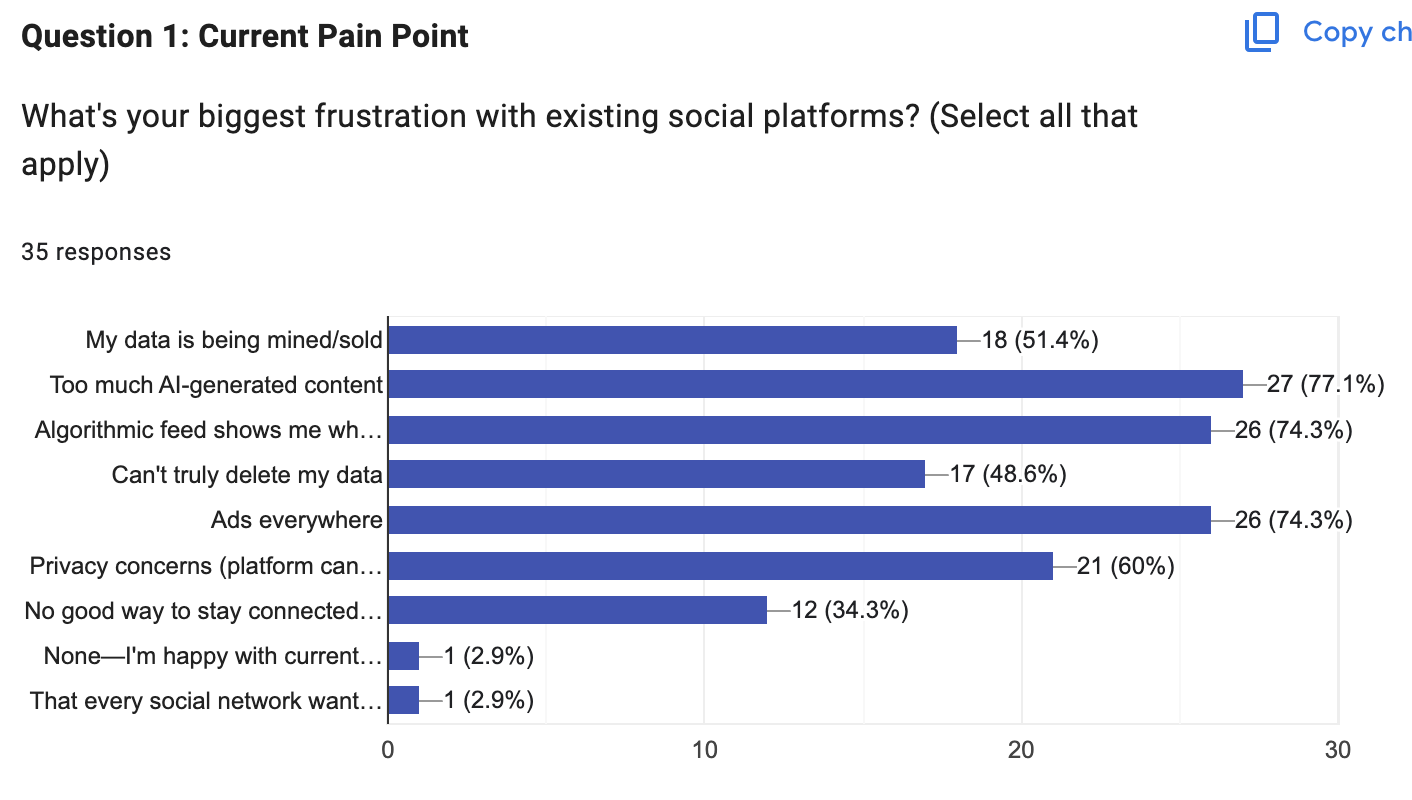
Let me be clear: Privacy still matters. A lot. But it's not what's making people miserable day-to-day.
Here's what people actually said when we asked them to describe their frustrations:
"My feed is full of AI slop and ads. I barely see posts from actual people anymore."
"The algorithm shows me everything EXCEPT what I want to see."
"I just want to see my friends' posts in order. That's it. Why is that so hard?"
Sound familiar?
The Connection I Didn't Expect
Here's what took me a moment to realise: these top 3 frustrations aren't separate from privacy concerns—they're what privacy violations actually look like in practice.
Ads everywhere? These are only possible because they're tracking everything you do to target you. Algorithm manipulation? Requires collecting data on what keeps you scrolling. AI-generated content? Trained on your posts without asking.
People don't hate "privacy violations" per se because its an abstract concept. But they definitely hate the ads, algorithms, and AI slop that such surveillance makes possible.
That's why encryption matters. Not just for security—but because when a platform can't read your posts, it literally can't build these types of systems even if it wanted to.
What People Actually Value (Spoiler: Not Discovery)
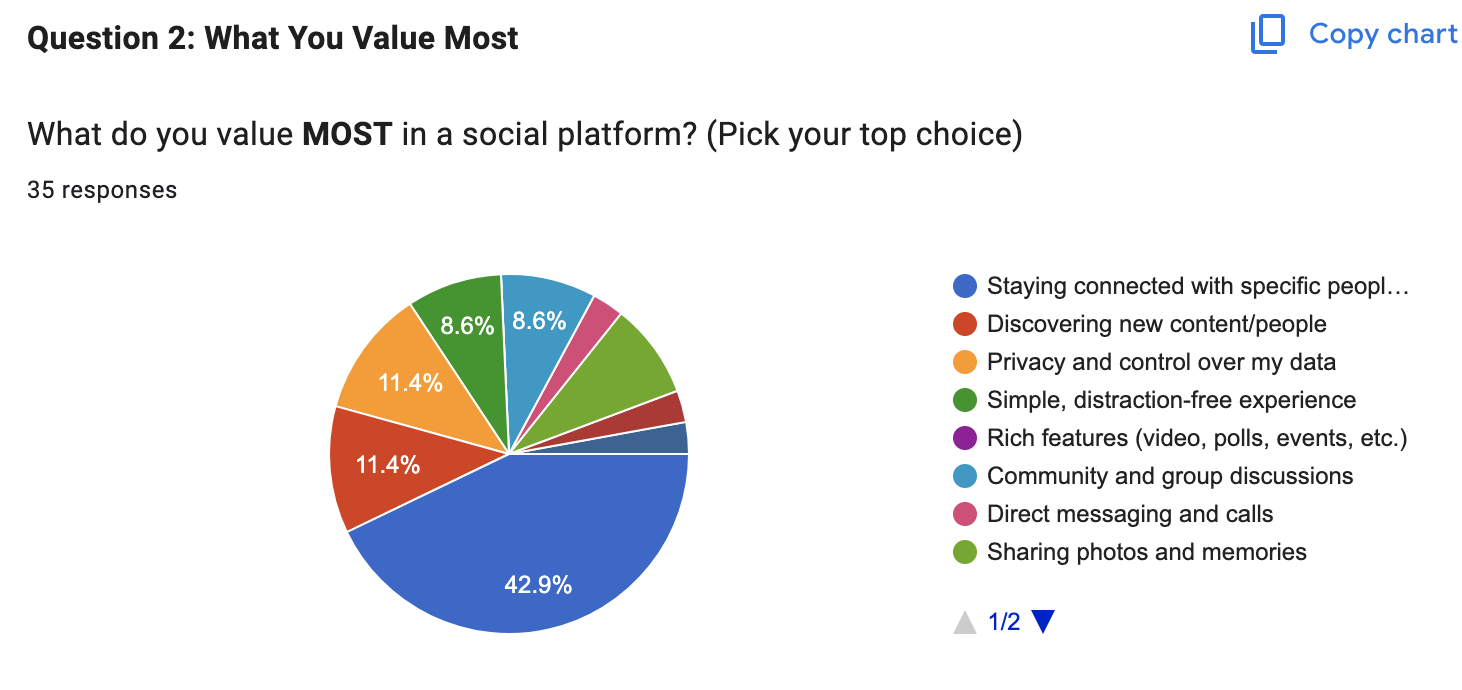
We asked: "What do you value MOST in a social platform?"
42.9% said "staying connected with specific people"
Only 11.4% said "discovering new content or people"
That's nearly 4 to 1.
Let that sink in.
The entire industry is optimized for endless discovery—scrolling through content from strangers, "For You" pages, algorithmic recommendations.
But most people just want a phone book with photos.
They don't want to discover new people. They want to stay connected with the people they already know and care about.
The platforms are solving a problem nobody has while ignoring the one everyone does.
The Network Effect Problem Is Worse Than I Thought
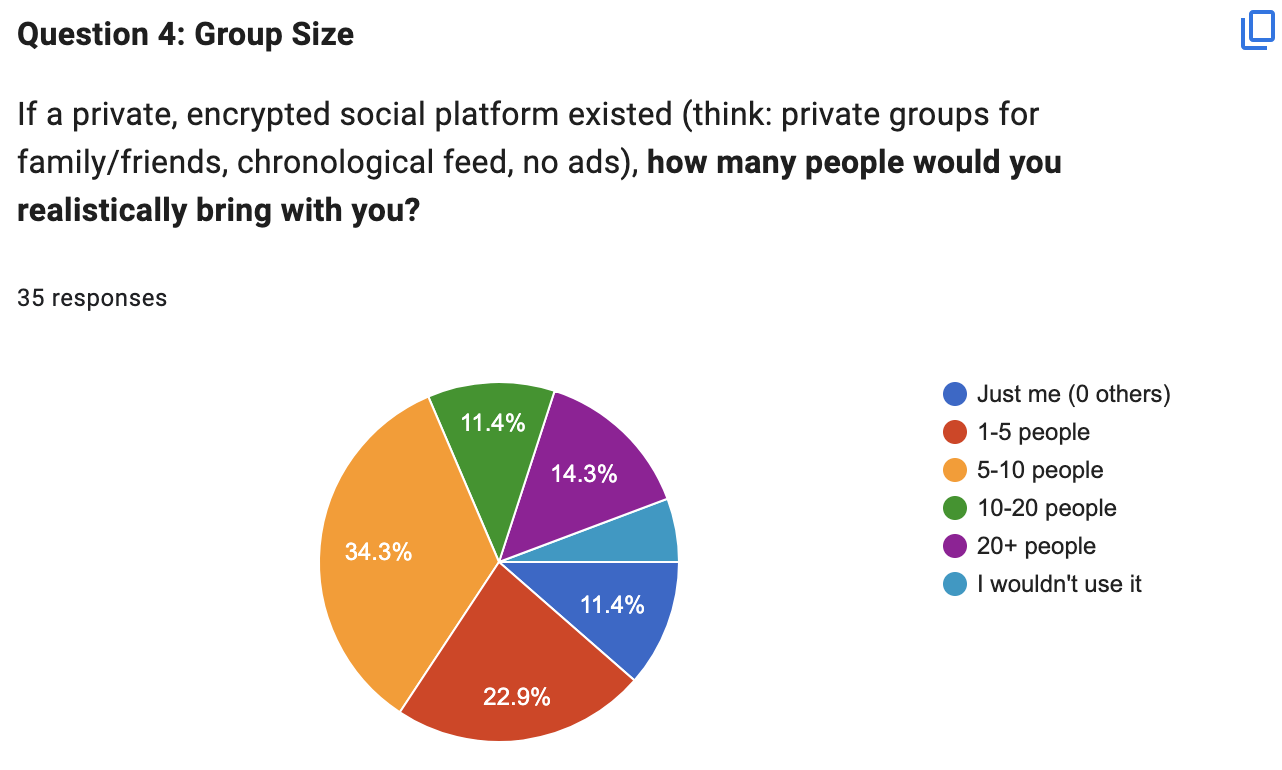
We asked: "If a private, encrypted social platform existed, how many people would you realistically bring?"
68.6% said they'd bring 10 people or fewer.
At first I thought: "OK, people want small networks."
Then I realised what they're actually saying: "I can't even convince 10 people to switch platforms."
This isn't about preference. It's about the reality of network effects.
People aren't saying they only want 10 connections total. They're saying that's the maximum number they could realistically get to overcome the switching friction—and even that feels optimistic.
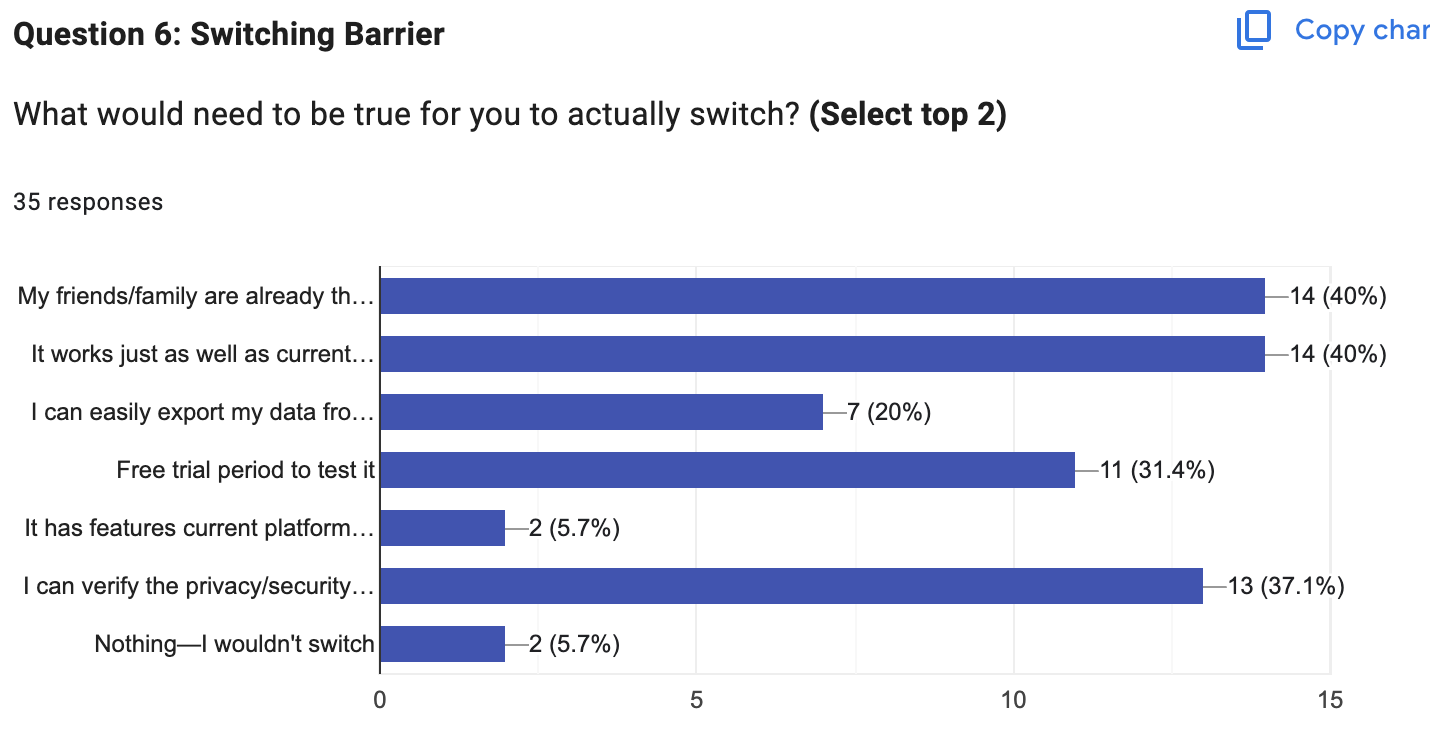
This connects directly to the biggest switching barrier: 40% said "my friends and family need to be there first."
It's not that people want tiny networks. It's that moving people between platforms is nearly impossible when everyone's already established somewhere else.
What People Actually Use (vs What Platforms Push)
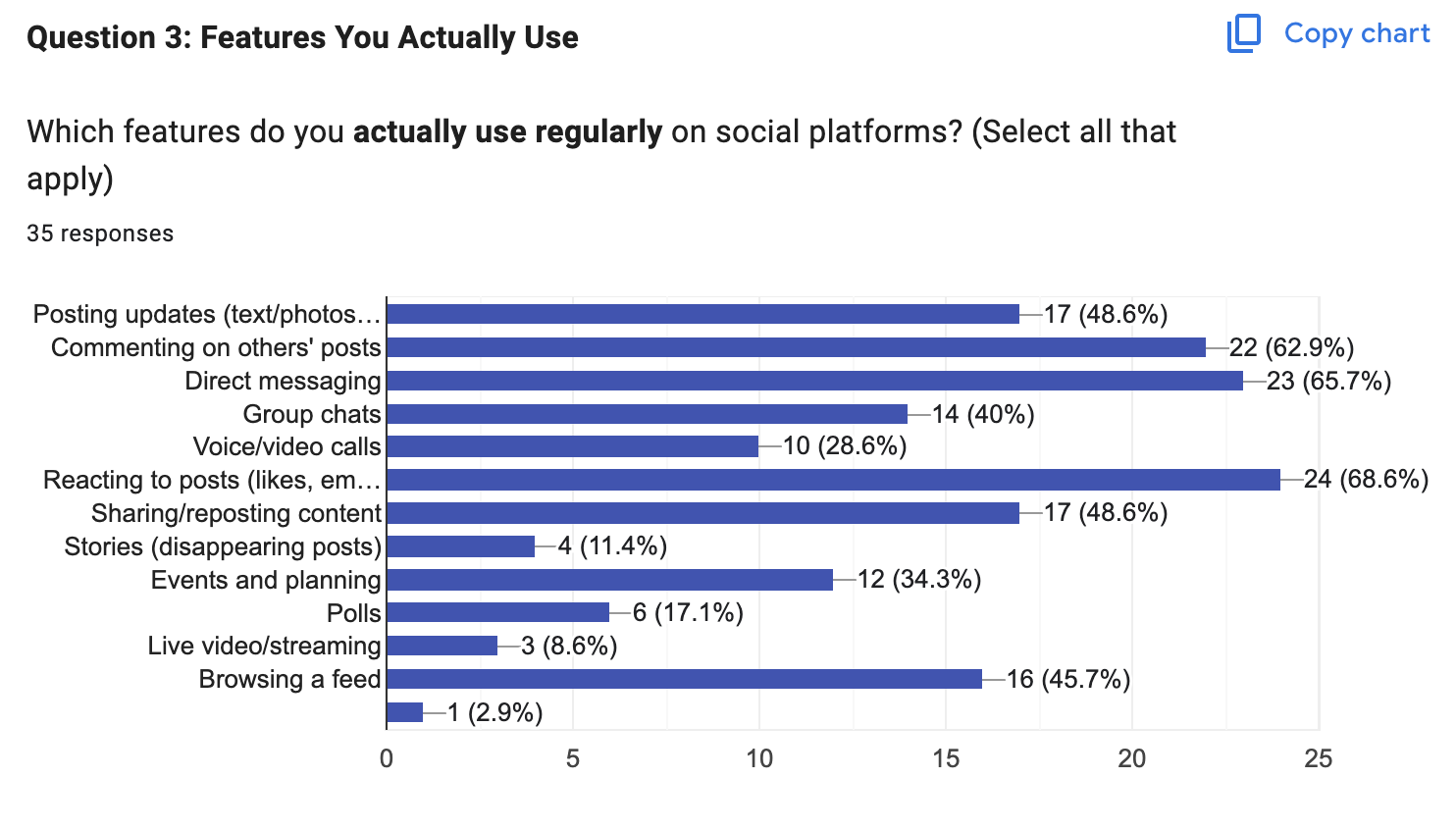
We asked which features people actually use regularly.
The top three?
68.6% - Reacting to posts (likes, emojis)
65.7% - Direct messaging
62.9% - Commenting
Only 48.6% actively post content.
So most people are lurkers and reactors. They're not content creators. They're not trying to build an audience.
They're just trying to stay in touch.
Meanwhile platforms keep pushing Stories, Live Video, Reels...
Features that almost nobody asked for. Only 11.4% regularly use Stories. Just 8.6% use live streaming.
The disconnect is wild.
The Interest vs Payment Gap
Here's where it gets interesting.
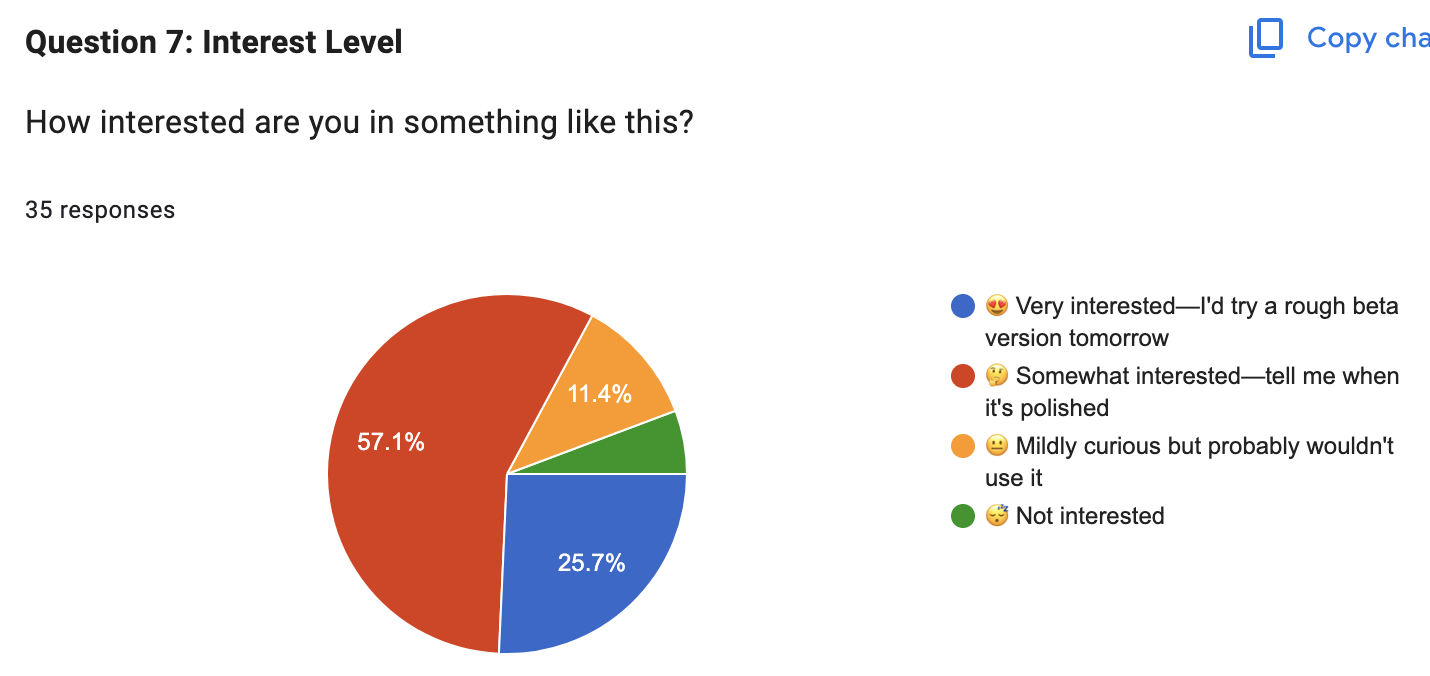
82.8% of people said they're interested in an alternative (25.7% very interested, 57.1% somewhat interested).
That's huge. Four out of five people want something better.
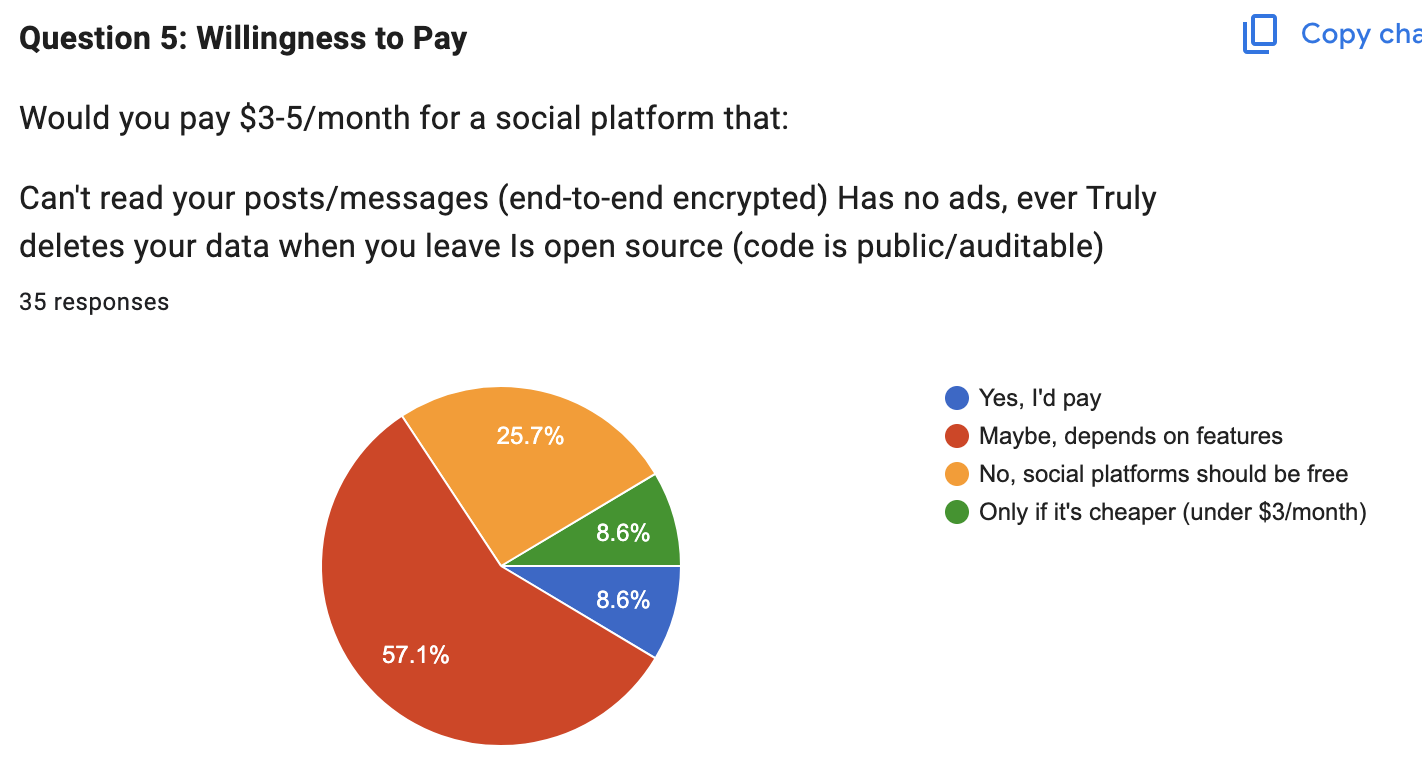
But when we asked if they'd pay €3-5/month for it?
Only 8.6% said yes definitely.
57.1% said "maybe, depends on features."
Translation: People want an alternative badly. But they need to be convinced it's worth paying for.
Which makes sense. We're trained to expect social media to be "free" (even though we're paying with our attention, data, and mental health).
This is the challenge. People are ready for change. They're just not ready to pay for it—yet.
The Network Effect Double-Bind
Now the picture becomes clear.
The two biggest switching barriers (tied at 40%):
1. "My friends and family need to be there"
2. "It needs to work as well as current platforms"
Combined with 68.6% saying they can only bring 10 people or fewer, you see the full scope of the problem:
People need their network to switch. But they can't move their network. So nobody switches.
It's not just chicken-and-egg. It's fully locked in.
Add in that 31.4% need a free trial period to test it first, and the switching friction becomes almost insurmountable.
This is why most social media alternatives fail. It's not that people don't want them. It's that the network effect barrier is so high that even motivated users can't overcome it.
This is exactly why Snugg needs the "founding members" approach.
You can't ask individuals to bring their entire network. That's impossible. But you CAN get some early adopters who each bring their 5-10 closest people.
That creates critical mass. Suddenly people aren't switching to an empty platform—they're joining something that already has momentum.
The data shows people can't solve this problem individually. But collectively? That's different.
What This Means for Snugg
Honestly? These findings are changing how I think about building Snugg.
What I'm doubling down on:
- UX simplicity - No algorithm. No ads. Just a chronological feed that actually works
- Passive interaction - Make it easy to react and comment, not pressure people to post constantly
- Core features done well - Direct messaging, photo sharing, simple posts. That's it.
- The founding members strategy - Because individuals can't overcome network effects alone, but a coordinated group of 1,000 can
What I'm not worried about:
- Competing with Facebook's features (nobody wants all those features anyway)
- Building tools for content creators (most people aren't creators)
- Discovery and algorithmic recommendations (people actively don't want this)
The biggest challenges:
1. Proving it's worth €3-5/month - The free trial period is critical. People need to experience how much better it is before they'll commit.
2. Solving the network effect problem - This is why the founding members approach matters. We need critical mass before we can ask people to bring their networks.
3. Making switching painless - If people can only convince 10 others to move, we need to make those 10 people feel like enough.
You're Not Alone
If you've felt like social media got terrible and you're not sure why—you're right. It did get terrible.
77% of people are sick of AI slop filling their feeds.
74% of people are drowning in ads.
74% of people can't find posts from actual humans they care about.
It's not just you.
And it's not an accident. It's by design.
These platforms make money by showing you ads and keeping you scrolling. Your preferences don't matter. Your time doesn't matter. The fact that you clicked X to hide something doesn't matter.
Their business model requires making you miserable.
What You Can Do
If you want to help shape these findings:
Take the survey: Survey Link
We're still collecting responses. Every answer helps us understand what people actually need (not what Silicon Valley thinks they need).
If you're sick of this:
Join the Snugg waitlist: Waitlist Link
We're building what should exist: private groups for people you actually know. No ads. No algorithm. No data mining.
Just real connection.
If you want to stay updated:
These are early findings. As we hit 50, 100, 200+ responses, the patterns will get clearer. We'll share everything we learn.
The Bottom Line
Three things are clear from this early data:
1. People are more frustrated by bad UX than by privacy violations - The daily assault of ads and algorithms hurts more than invisible data mining
2. Most people want connection with their existing network, not endless discovery - They value "staying connected with specific people" 4x more than discovering new ones
3. The network effect barrier is brutal - Even motivated users think they can only convince 10 people or fewer to switch, which makes the collective "1,000 founding members" approach essential
Here's what I know for sure: Social media doesn't have to be this way.
These platforms won't fix it because the problem IS their business model. They make billions by keeping you scrolling, miserable, and seeing ads.
But we can build something different.
Something that works for you. Not for advertisers.
Thanks to everyone who's taken the survey so far. Your honest answers are shaping Snugg into what it needs to be.
And to the 57% who said "maybe, depends on features"—I hear you. We've got work to do to prove this is worth it.
Let's build something better together.
Want to help? Take the survey | Join the waitlist | [Share this post]
Methodology Note: This analysis is based on 35 survey responses collected January 2026. We're continuing to gather data and will update findings as the sample size grows. All percentages are from the current dataset and should be considered preliminary insights rather than definitive conclusions.